Identification
What Does Woodworm Look Like? The Complete Visual Guide
Exit holes, bore dust, tunnels and live beetles — a complete visual guide to identifying woodworm, telling active from historic, and knowing when to call a professional.
By The WoodwormTreatmentHQ Team · Updated 3 June 2026
Found something suspicious in your timber? Small round holes, a little pile of dust, or an insect you can’t identify? This guide walks through every visual sign of woodworm — what each one looks like, what it tells you, and what to do next.
The first thing to understand is that “woodworm” is not actually a worm. It is the larval stage of several wood-boring beetle species. The larvae burrow unseen inside timber for years, and the telltale signs you spot on the surface are almost always left by the adults as they exit — not by the larvae themselves. That matters for diagnosis, because some of what you see may be years old.
The exit holes
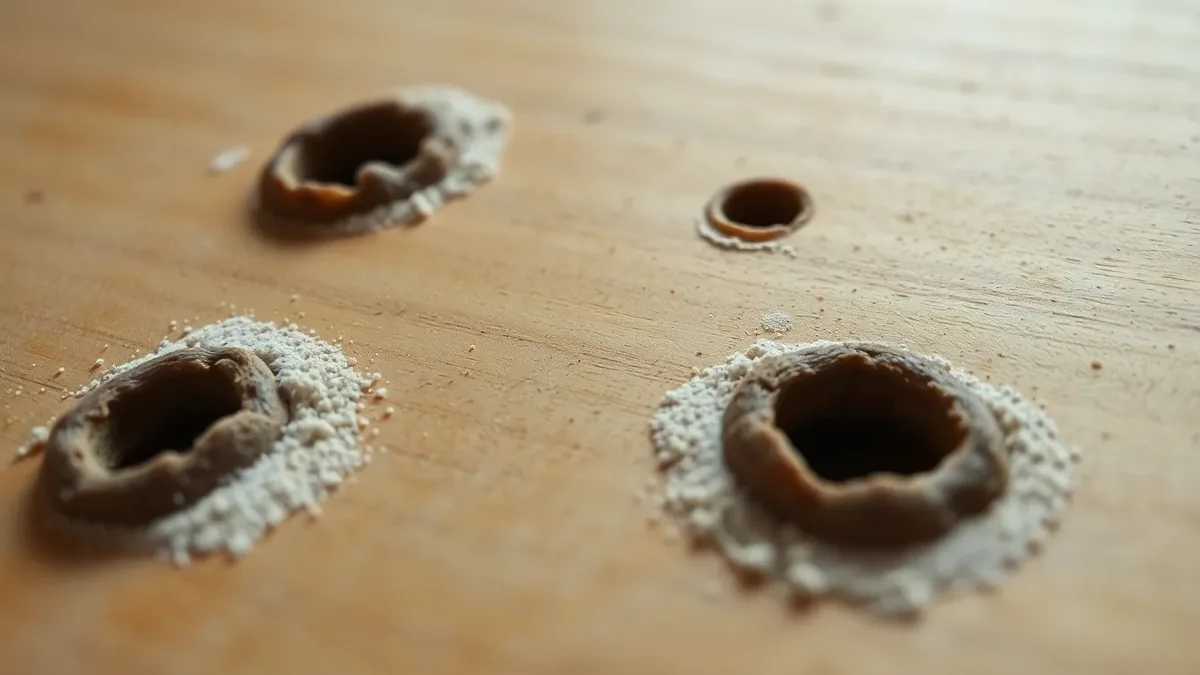
Exit holes are the most obvious sign. When an adult woodworm beetle emerges from timber, it bores a clean round hole through the surface. What to look for:
- Shape: Perfectly round or very slightly oval, with clean, sharp edges
- Size: 1–2mm for the common furniture beetle (Anobium punctatum), 3mm for deathwatch beetle, 6–10mm and oval for house longhorn beetle
- Colour: Fresh holes are pale, almost white inside. Old holes darken to brown or grey over time as dust and oxidation settle in
The hole size is one of the most reliable species indicators. A cluster of 1–2mm holes in softwood almost certainly means common furniture beetle. Larger, 3mm holes in old oak structural beams suggest deathwatch beetle.
One critical point: holes alone cannot tell you whether an infestation is active or historic. A timber can be covered in clean-looking holes from a beetle population that died out twenty years ago, or have just one or two fresh holes from a live population that hatched this summer. Active vs historic needs more than just the holes.
Bore dust (frass)
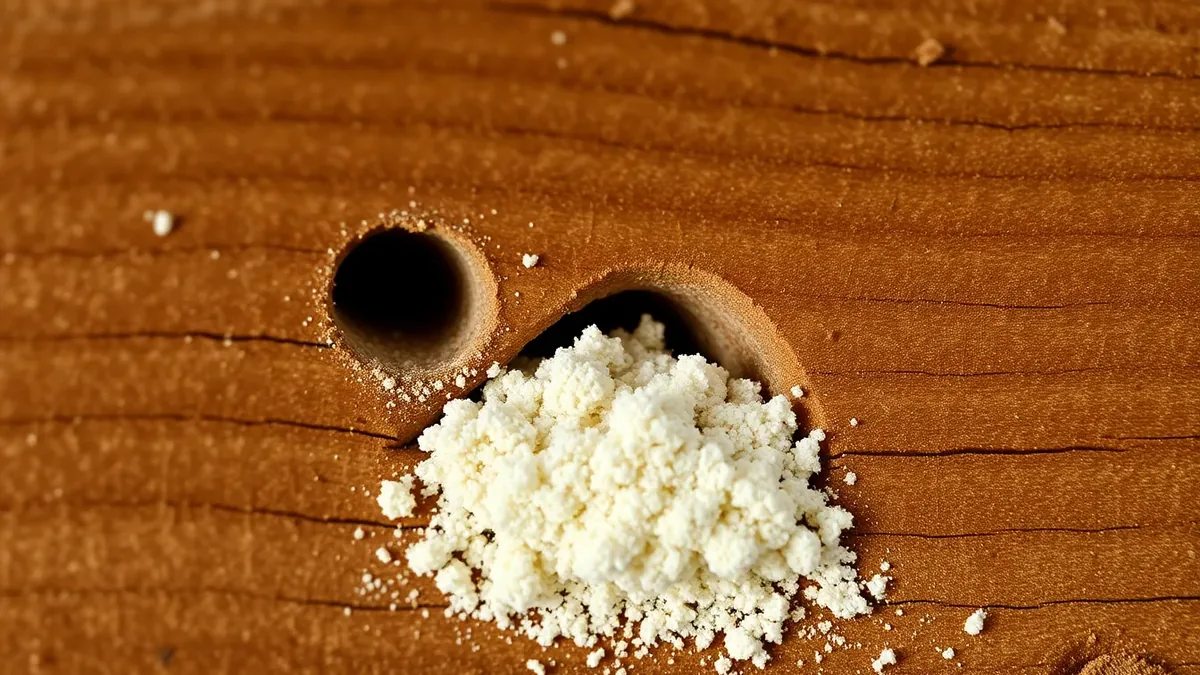
Bore dust — also called frass — is the powdery debris left by the emerging beetle as it chews its way out. This is arguably the most important active/historic indicator.
- Colour: Fresh frass is cream to pale yellow, almost white
- Texture: Fine, powdery, sometimes with tiny round pellets mixed in — visible under a loupe
- Location: Sits in small piles directly beneath exit holes, or in the cracks and corners of affected furniture
- Age test: Brush away or blow off any visible frass, then check again in spring and early summer. Fresh frass reappearing indicates active beetles
Old frass that has been sitting for years turns grey, consolidates and loses the powdery quality. If frass looks dusty grey and compacted, the infestation may be historic. Fresh, loose, pale frass beneath recent-looking holes is the strongest single indicator of active woodworm.

Tunnels and galleries inside the timber
If you break or cut into suspected timber, you may see the internal evidence directly. Woodworm larvae spend their entire developmental phase — three to five years for common furniture beetle — boring a network of tunnels through the wood.
- Appearance: Winding tunnels, roughly circular in cross-section, following the grain and sapwood layers
- Fill: Fresh tunnels contain loose frass. Old tunnels in abandoned timber may be empty and dusty
- Structural damage: A heavily infested timber looks almost hollow when cut through — the internal structure has been converted to a matrix of tunnels and frass with only a thin outer shell of wood remaining
Timber that feels soft and spongy, crumbles easily or collapses when probed with a screwdriver is likely to have significant larval galleries beneath the surface. This is a structural warning sign.
Live and dead beetles
You are most likely to find adult woodworm beetles in May, June, July and August — the flight season. Adults emerge from timber, mate, and lay eggs on or in cracks in nearby wood. Their lifespan above the surface is measured in days to weeks.
What you might see:
- Adult common furniture beetle: 2.5–5mm long, dark brown to reddish-brown, oval body with a distinctive hood-like projection (pronotum) covering the head, ribbed wing cases. Often found near windowsills — adults are attracted to light
- Dead beetles: Small brown husks on windowsills, near exit holes, or caught in spiders’ webs. Often found without seeing a live beetle
- Deathwatch beetle: Slightly larger (5–7mm), mottled greyish-brown with patches of yellowish hairs. Produces a ticking sound by knocking its head on timber — the origin of its name
- House longhorn beetle: Much larger (8–20mm), grey-black with white patches. Oval exit holes 6–10mm wide
Finding a live adult beetle near exposed timber is strong evidence of an active infestation — the adults do not hang around long after emergence.
Damaged or crumbling wood
Surface damage visible without cutting into the timber:
- Soft surface: Press firmly with a screwdriver or sharp probe. Healthy timber resists; heavily infested timber gives way with little force
- Surface crumbling: Where infestation has been extreme, the timber surface itself crumbles, particularly around exit hole clusters
- Structural weakness: Floor joists, rafters and structural beams with heavy woodworm may flex, sag or crack. Any structural timber showing movement along with exit holes needs immediate assessment
Where to look
Woodworm shows up in predictable places. Concentrate your inspection here:
- Loft rafters and roof joists — cool, damp, rarely disturbed
- Sub-floor voids and floor joists — especially in older suspended timber ground floors with blocked air bricks
- Skirting boards — original pine skirtings in period properties, especially near damp external walls
- Furniture — antique and second-hand furniture, particularly unfinished undersides, drawer runners and hidden surfaces
- Structural beams — particularly in older buildings with hardwood structural elements
Active vs historic: the key question
If you see holes and frass, the essential question is whether the infestation is still live. A historic infestation needs no treatment. An active one does. The indicators:
| Sign | Active | Historic |
|---|---|---|
| Frass colour | Pale cream/white | Grey, compacted |
| Hole edges | Clean, pale inside | Dark, dusty |
| Frass volume | Growing (reappears after brushing) | Static |
| Adult beetles | Present May–August | Absent |
| Timber condition | Deteriorating | Stable |
When in doubt, a free survey by a qualified specialist removes the uncertainty completely. Read our full guide to active vs historic woodworm for more detail on each indicator.
When to call a professional
DIY assessment is useful for catching obvious signs, but call a professional if:
- Exit holes appear in structural timber (joists, rafters, beams)
- Timber feels soft, spongy or crumbles easily
- Holes are larger than 3mm — deathwatch or longhorn beetle need specialist treatment
- You are buying or selling a property
- You cannot determine whether the infestation is active or historic
A free woodworm survey confirms the species, assesses whether it is active, and scopes any treatment needed — with no obligation to proceed.