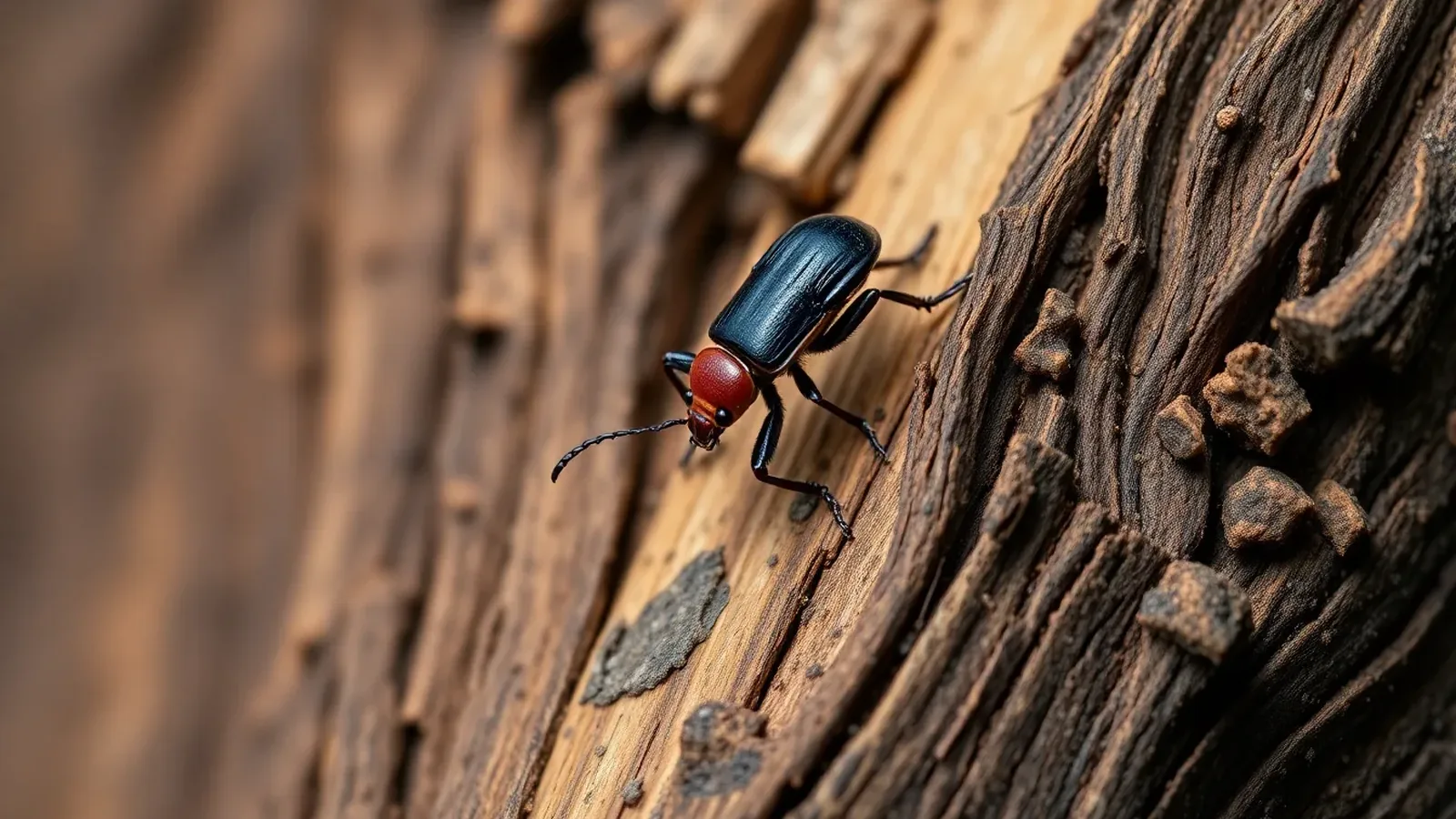
Bark Borer Beetle
A beetle of bark and rough softwood edges. It is often mistaken for furniture beetle, and it rarely needs treatment.
- Holes are about 1 to 2mm wide
- It stays in bark and the outer wood
- Most cases need no treatment
What to know about the bark borer beetle
The bark borer lives in the bark and the thin wood just under it. It mostly affects softwood that still has bark, such as rustic beams or roof timbers with rough edges. The beetle cannot live in dry, seasoned wood for long.
People often mistake it for the furniture beetle because the holes look alike. However, the bark borer rarely harms the structure. A survey can tell the two apart.
| At a glance | |
|---|---|
| Latin name | Ernobius mollis |
| Adult size | About 3 to 5mm |
| Exit holes | Round, about 1 to 2mm |
| Timber | Softwood bark and edges |
| Active season | Spring and summer |
How to recognise it
You will usually see the damage before you see the beetle. Four clues give it away, because each one leaves a mark.
The adult beetle
It is small and brown with a rounded body. It looks like a furniture beetle at a glance.
The exit holes
Holes are round and small. They sit in bark or on the edge of a board.
Bore dust (frass)
The dust contains bark fragments. It sits mostly near the surface.
Limited damage
Tunnels stay in the bark and outer layer. Sound inner wood is usually untouched.
How the beetle develops
The beetle breeds in bark. When the bark dries or falls away, the colony usually dies out.
Because the beetle needs bark, it does not usually reinfest seasoned timber. A new batch of bark-on wood could still bring it in.
- 1
Egg
The female lays eggs under bark and in rough edges. They hatch within a few weeks.
- 2
Larva
The grub feeds in the bark and the thin wood below. It rarely goes deeper, because the sound wood is too hard.
- 3
Pupa
The larva pupates near the surface. This happens in late spring.
- 4
Adult
The adult emerges through a small round hole. It lives for only a short time.
Where it lives and what it does
Knowing its favourite places helps you check the right spots, since each beetle has habits.
Where it is found
Look at rustic beams, log walls and roof timber with bark. Sheds and outbuildings are typical.
The damage it does
It is mostly cosmetic. The outer layer may crumble, but the core is rarely hurt.
How worried to be
Low. Check that it is not furniture beetle, which does need action.
How the bark borer beetle is treated
The method depends on the beetle, because each species needs a different approach.
Most bark borer cases need no treatment. You can brush off loose bark and dust, then watch the timber for a season. If a surveyor is unsure of the species, a light spray may be advised.
Always confirm the species first. A wrong guess could leave a real furniture beetle problem untreated.
Help in your area
This applies across the UK, but housing differs by city. For local detail, read about woodworm treatment in London and woodworm treatment in Manchester, because older streets hold more old timber.
Bark Borer Beetle: your questions
Is the bark borer harmful?
Rarely. It stays in the bark and the outer wood. Sound inner timber is usually fine.
How can I tell it from furniture beetle?
Look for bark on the timber and bark in the dust. A survey gives a firm answer.
Do I need to treat it?
Often not. A specialist will tell you if treatment is worth doing.
Will it come back?
Only if you bring in new timber with bark. Seasoned wood is rarely attacked.
Helpful next steps
Found signs of the bark borer beetle?
Send your postcode and what you have seen, because the right treatment depends on the species. A local specialist will call to arrange a survey.