Guides
Treating Woodworm with WD40: Does It Actually Work?
WD-40 is one of the most common DIY woodworm fixes suggested online. Here is the honest answer: why it fails, what actually kills woodworm, and when you need a professional.
By The WoodwormTreatmentHQ Team · Updated 3 June 2026
Type “woodworm treatment” into any DIY forum and WD-40 will appear within the first few replies. It is cheap, it is in almost every garden shed, and it has a mythical reputation as a cure for almost everything. For woodworm, however, it does not work — and understanding why will help you choose something that does.
What WD-40 actually is
Before explaining why WD-40 fails against woodworm, it helps to understand what it is. WD-40 is not an insecticide. It is a water-displacing petroleum-based lubricant and corrosion inhibitor. The “WD” stands for Water Displacement, formula 40 — it was developed in 1953 to protect missile components from rust.
It contains light mineral spirits, carbon dioxide propellant and some lubricating oils. There is nothing in the formulation designed to penetrate wood, kill insects or reach larval galleries inside timber.
Why WD-40 does not kill woodworm
1. It cannot reach the larvae
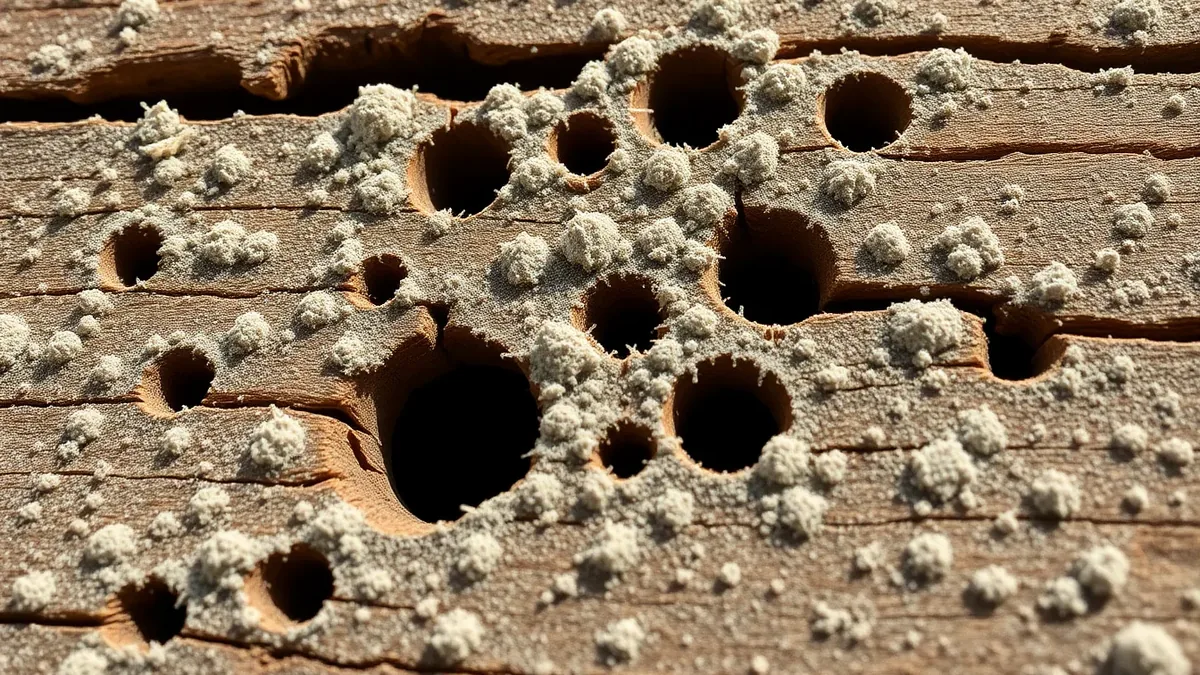
Woodworm damage is caused by larvae boring tunnels inside timber. These larvae spend three to five years entirely within the wood, up to several centimetres below the surface. WD-40 sprayed into an exit hole will travel a few millimetres into the opening but will not penetrate the full depth of the larval galleries. The larvae are completely unaffected.
2. It is not an insecticide
WD-40 has no active ingredient that kills insects. Even if it were to contact an adult beetle or larva directly, its effects are limited to smothering — which requires direct, sustained contact. Through a 1–2mm hole in timber, that is not achievable.
3. It may temporarily repel adults but does not prevent re-infestation
The petroleum smell of WD-40 may briefly deter adult beetles from laying eggs on a treated surface. But this effect is temporary — it dissipates within weeks — and does nothing about the larvae already inside.
4. It can seal exit holes without killing what is inside
One of the more counterproductive uses of WD-40 is spraying it into visible exit holes. If the holes are sealed by the oil film, newly emerging adults may be trapped — but this creates no long-term benefit. The larvae behind them are still feeding, and future adults will create new exit holes.
What actually kills woodworm
Two classes of professional treatment are effective:
Permethrin-based spray treatment
Permethrin is a synthetic pyrethroid insecticide — it is derived from compounds naturally found in chrysanthemum flowers and is highly toxic to insects while being low-risk to mammals when used as directed.
Professional woodworm treatments use water-based permethrin formulations that:
- Penetrate the outer layers of timber through capillary action — not just coating the surface
- Are absorbed by pupae forming just below the surface and by emerging adult beetles
- Persist in the timber for years, continuing to kill adults as they emerge
- Have a no-smell, no-solvent formulation that is safe for use in occupied properties once dry
Permethrin spray is the standard treatment for common furniture beetle in accessible softwood — floor joists, rafters, skirtings and furniture.
Boron gel and paste treatment
For structural timber, joist ends embedded in masonry, and harder-to-reach infestations, boron-based treatments penetrate much more deeply than spray formulations. Boron is toxic to wood-boring beetle larvae across all life stages and diffuses through timber over time, remaining effective for decades.
Boron paste is the treatment of choice for deathwatch beetle in hardwood structural beams and for heavy furniture beetle infestations in structural softwood.
When is DIY treatment enough?
For small, isolated infestations in furniture or non-structural softwood, a proprietary permethrin spray from a hardware store can be effective — provided you apply it correctly:
- Apply in late spring (April–May) before adults emerge
- Penetrate all exit holes, cracks and end grain as well as surface areas
- Allow full drying and ventilation before the room is reoccupied
- Repeat for two consecutive seasons to break the life cycle
DIY works when: The infestation is in furniture, a small area of flooring or a non-structural surface; the timber is accessible; the species is common furniture beetle; and the infestation is not extensive.
When you need a professional
Call a professional if any of these apply:
- Structural timber is affected — floor joists, roof rafters, structural beams. Getting treatment wrong here carries a genuine structural risk
- The holes are larger than 2mm — deathwatch or longhorn beetle require different treatment and professional diagnosis
- The infestation covers a large area — a whole roof space or multiple rooms of flooring needs a systematic professional approach
- You are buying or selling — a mortgage survey may require a professional treatment certificate with a guarantee
- You have tried DIY and it has not worked — two seasons of DIY permethrin with no improvement means specialist assessment is needed
A free woodworm survey from a qualified specialist will confirm the species, tell you whether the infestation is active, and give you a clear treatment recommendation — with no obligation to proceed. That clarity is worth more than a can of WD-40.
Read more: Best woodworm treatment products · DIY vs professional woodworm treatment · Woodworm treatment cost