Identification
Woodworm Life Cycle: Egg, Larva, Pupa, Adult — Explained
A clear guide to the woodworm life cycle — four stages from egg to adult beetle, how long each takes, and why the timing matters for treatment.
By The WoodwormTreatmentHQ Team · Updated 3 June 2026
The woodworm life cycle is one of the most important things to understand about a woodworm infestation — not because it is complicated, but because it explains why an infestation can remain invisible for years, and why the timing of treatment matters.
The common furniture beetle (Anobium punctatum) — responsible for around 75% of UK infestations — takes three to five years to complete a single life cycle. Almost all of that time is spent as a larva, invisible inside the timber. The exit holes and frass you see on the surface are evidence of the adults emerging at the end of that cycle — by which time the larvae of the next generation are already feeding inside.
Stage 1 — Egg
Adult female beetles lay their eggs in cracks, crevices, old exit holes and rough-grained timber surfaces. Smooth, painted or varnished surfaces are generally avoided because the beetle cannot get a purchase for egg-laying.
- Number of eggs: A single female common furniture beetle lays 20–60 eggs
- Location: In crevices in unfinished timber, inside existing exit holes, along the grain on rough surfaces
- Hatching time: 2–5 weeks, depending on temperature and humidity
- Appearance: Tiny, oval, white — invisible to the naked eye without magnification
Higher temperatures in summer accelerate hatching. Cool, damp conditions slow development but do not stop it — the furniture beetle is well-adapted to the cool, poorly-ventilated voids typical of British housing.
Stage 2 — Larva
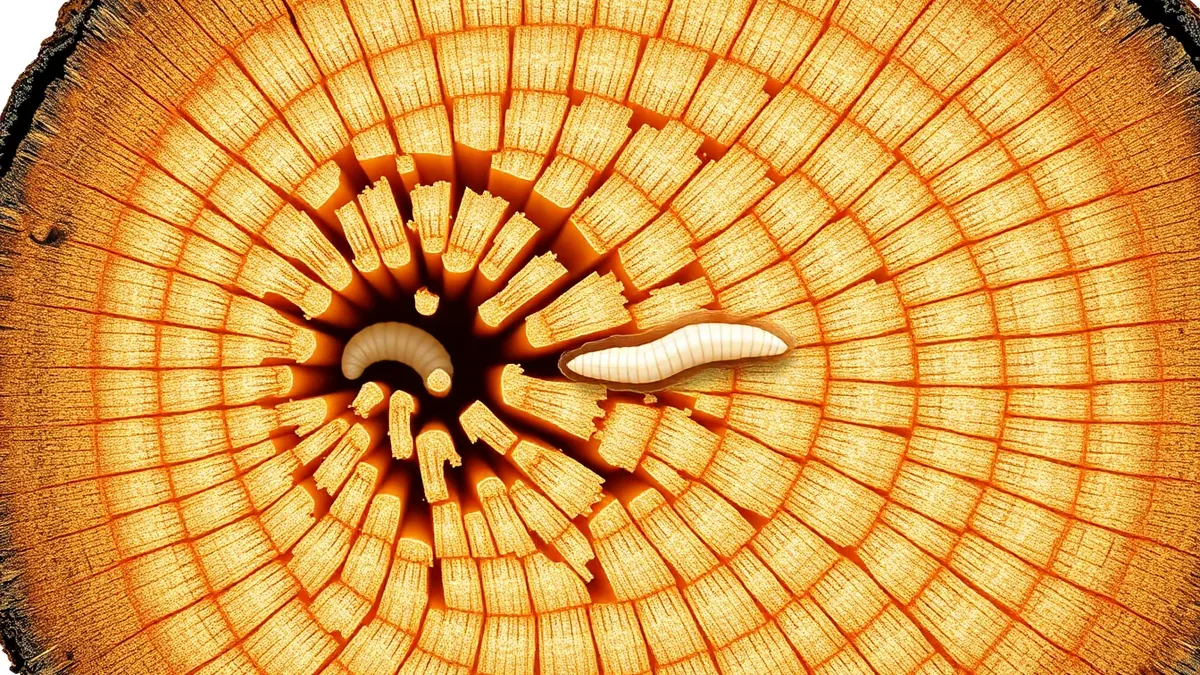
The larval stage is where all the damage happens. As soon as the egg hatches, the larva bores immediately into the timber and begins feeding. From this point until emergence as an adult, the larva remains inside the wood — entirely invisible from the surface.
- Appearance: Cream-white, C-shaped grub, 1–5mm when young, up to 6mm at full development
- Duration: Three to five years for common furniture beetle; up to ten years for deathwatch beetle
- Activity: Continuous tunnelling along the grain, feeding on starch and cellulose in the sapwood
- Frass: The larva produces bore dust (frass) as it feeds — a mixture of chewed wood fibres and excrement that fills the tunnels behind it
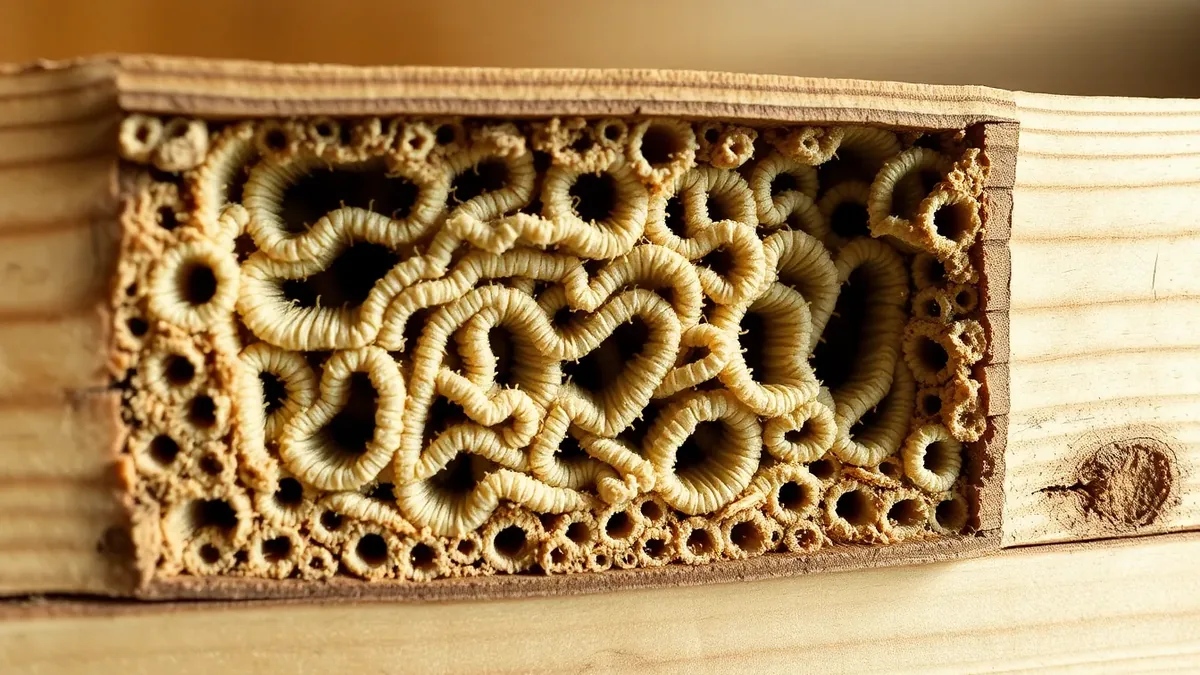
The larva follows a characteristically winding path through the timber, creating the network of galleries that gives heavily infested wood its hollow, spongy quality. It preferentially attacks sapwood (the outer growth rings) rather than heartwood, which is why you often see heavy exit hole concentrations on the edges of beams.
A single larva bores only a small tunnel. The structural damage associated with woodworm is cumulative: from many larvae boring through the same piece of timber over several generations.

Stage 3 — Pupa
After completing larval development, the woodworm moves close to the surface of the timber and forms a small pupal chamber — an oval cavity just below the surface where the transformation from larva to adult takes place.
- Location: Just beneath the timber surface, often within 2–3mm
- Duration: 6–8 weeks
- Appearance: The pupa is white and grub-like, gradually developing the recognisable form of the adult beetle
This pupal chamber is why woodworm treatment applied to the surface is effective — permethrin-based treatments penetrate into the outer millimetres of timber and are absorbed by the pupa and the newly formed adult beetle as it prepares to chew its way out.
Stage 4 — Adult beetle
The adult beetle chews through the thin layer of wood separating the pupal chamber from the surface, creating the distinctive round exit hole. This is the single visible moment of the entire four-year cycle.
- Emergence period: May to September, with peak activity in June and July
- Lifespan: Two to four weeks — just long enough to find a mate
- Behaviour: Adults are attracted to light and will fly to windows. They do not feed — their only purpose is reproduction
- Reproduction: Mating occurs near the emergence site; females immediately begin seeking timber surfaces to lay eggs, starting the cycle again
The adult beetle’s short lifespan explains why you often find dead beetles or husks near exit holes or on windowsills, rather than live insects.
How long does the full woodworm life cycle take?
| Species | Egg hatching | Larval stage | Pupal stage | Total cycle |
|---|---|---|---|---|
| Common furniture beetle | 2–5 weeks | 3–5 years | 6–8 weeks | 3–5 years |
| Deathwatch beetle | 3–6 weeks | 4–10 years | 8–12 weeks | 4–10 years |
| House longhorn beetle | 2–4 weeks | 3–11 years | 6–10 weeks | 3–11 years |
| Powderpost beetle | 1–2 weeks | 6 months–3 years | 2–3 weeks | 1–3 years |
Why the life cycle matters for treatment
Understanding the cycle has three practical implications:
1. Treat before the flight season
The most effective time to apply surface treatments is late spring — April to May — before adults emerge. Permethrin spray applied to exit holes and timber surfaces is absorbed by pupae and emerging adults, killing them before they can reproduce.
2. Surface treatment penetrates to where it matters
Permethrin-based treatments are specifically formulated to penetrate the outer layers of timber where pupal chambers are located. Applying treatment in spring means fresh pupae are forming just below the surface and the chemical is most effective.
3. New holes do not mean a new infestation
Finding new exit holes each summer does not mean the infestation is growing rapidly. It means adults are completing a cycle that began three to five years ago. Conversely, an absence of new holes for two or three consecutive summers after treatment is a strong sign of eradication.
How to tell if woodworm is still in its larval stage
If you cannot inspect during the May–September flight season, look for:
- Fresh frass: Brush away any visible bore dust and check again 2–4 weeks later. Reappearing pale, powdery frass indicates active larvae below
- Soft or spongy timber: Probe with a sharp implement — easy penetration suggests active gallery formation
- Recent exit holes: Pale, clean-edged holes with pale interiors suggest recent emergence
A free woodworm survey gives you a definitive active/historic verdict from a qualified specialist — and peace of mind without guessing.
Read more: What does woodworm look like? · Active vs historic woodworm · Signs of woodworm