Guides
Woodworm in Structural Beams: Risk, Treatment & When to Worry
Structural beams are the highest-risk site for serious woodworm. Here is how to inspect them, which species to look for, when timber is unsafe and what treatment involves.
By The WoodwormTreatmentHQ Team · Updated 3 June 2026
Woodworm in structural beams is a different category of problem from woodworm in furniture or floorboards. Structural timber — the beams, joists, rafters and purlins that carry the loads of a building — cannot simply be cosmetically treated and monitored. If woodworm has been active in structural timber for multiple generations, the internal damage may significantly exceed what the surface reveals.
This guide explains which species attack structural timber, how to inspect beams, when to be genuinely concerned, and what treatment and repair look like.
Which species attack structural beams?
Not all woodworm species are a structural concern. The relevant species are:
Deathwatch beetle (Xestobium rufovillosum)
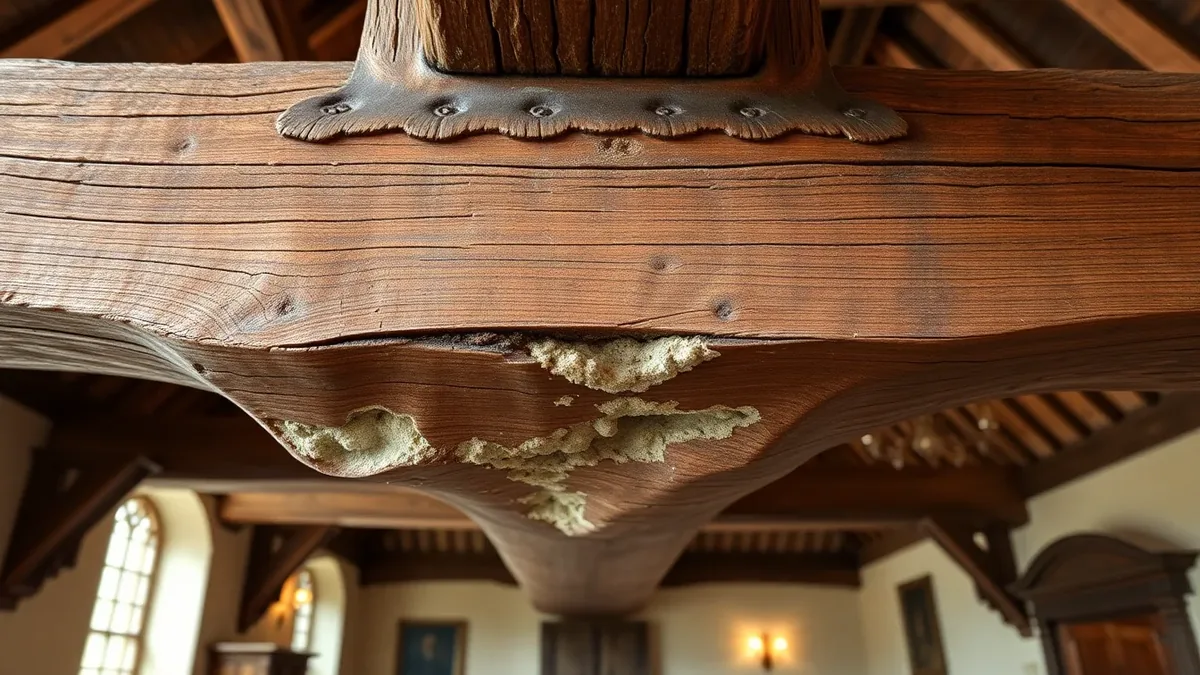
The most serious threat to structural hardwood in the UK. Deathwatch beetle is exclusively a hardwood species — it attacks old oak, elm, chestnut and similar structural timbers in historic buildings, farmhouses and any pre-twentieth-century property with significant original hardwood structure.
- Exit holes: 3mm round, often in dense clusters
- Preferred timber: Old hardwood with elevated moisture content (14%+ required)
- Structural risk: Very high. Deathwatch beetle can hollow a structural beam while leaving the outer skin almost intact. Beams that appear sound from below may have lost 60–70% of their structural cross-section
- Indicators: Ticking sound in late spring (adults knocking heads on timber); clusters of 3mm holes in oak or elm; honey-brown, biscuit-like frass
House longhorn beetle (Hylotrupes bajulus)
Targets softwood roof timbers — rafters, purlins and ridge boards. Most prevalent in parts of Surrey, North Hampshire and West Sussex but occasionally found elsewhere.
- Exit holes: 6–10mm, distinctly oval
- Preferred timber: Softwood — pine, spruce, larch
- Structural risk: Catastrophic if established. House longhorn larvae hollow softwood rafters almost completely while leaving the outer skin intact; affected rafters may look sound but collapse under load. Treatment requires specialist intervention; in Surrey postcodes, the house longhorn beetle has been subject to statutory eradication provisions
- Indicators: Large, oval exit holes in roof timber; exit holes often ragged-edged; timber sounds hollow when tapped
Common furniture beetle (Anobium punctatum) in structural softwood
While generally associated with furniture and floorboards, furniture beetle can and does infest structural softwood — floor joists, rafters and wall plates. In long-running infestations over multiple generations, the cumulative gallery network in joists can reduce structural section.
- Exit holes: 1–2mm round
- Risk level: Moderate to significant over time, but lower immediate risk than deathwatch or longhorn
How to inspect structural beams
Visual inspection
- Look for exit holes on all accessible faces — top, bottom and sides
- Note hole size (critical for species identification)
- Look for frass in the joints between beams, in cobwebs below beams, and on ledges beneath the timber
- Check all faces of the beam — infestations often start on the top or side faces where egg-laying conditions are most favourable
The probe test
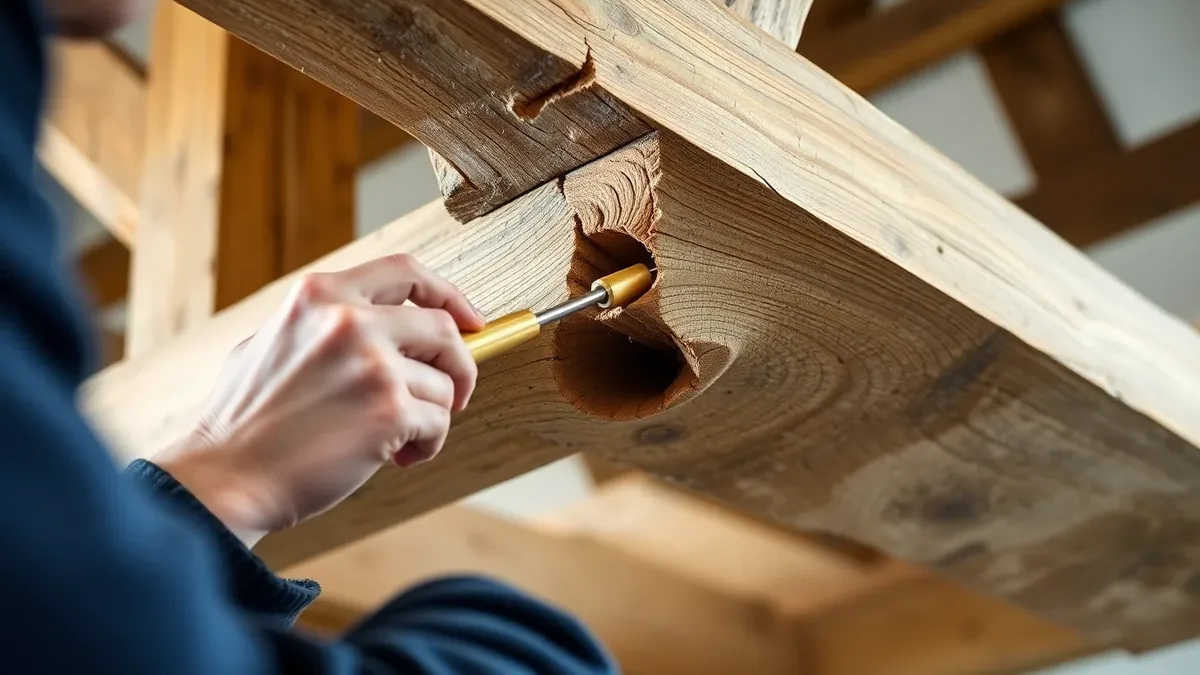
Push a sharp bradawl or probe firmly into the timber surface every 15–20cm, including areas without visible exit holes. In sound timber, the probe resists at the surface. In heavily infested timber with internal galleries, the probe sinks more easily than expected, or breaks through into a gallery.
This is the most reliable field test for internal structural damage beyond what exit holes reveal.
Tap test
Tap along the length of the beam with a rubber mallet or the handle of a screwdriver. Sound timber has a solid thud; timber with significant internal galleries sounds hollow or dead.
Moisture content
Use a pin-type moisture meter. Readings above 14–16% in hardwood beams suggest the moisture conditions that sustain deathwatch beetle. Dry timber (below 12%) rarely supports active deathwatch infestation.

When is a structural beam unsafe?
There is no single threshold, because structural safety depends on the cross-section of the beam, the loads it carries and the extent of gallery damage. However, the following are serious warning signs requiring structural assessment:
- Probe test penetrates more than 10mm without significant resistance in multiple places across the beam
- Hollow sound over more than 30% of the beam surface on tapping
- Visible deflection, sagging or cracking — particularly in joists and rafters under load
- Surface crumbling — the outer skin of the beam disintegrates when touched
- House longhorn beetle identified in a roof timber — immediate structural engineer assessment required
When a structural engineer is needed, woodworm treatment and structural assessment should be coordinated. There is no point treating a beam that needs replacing; and replacing a beam that could be treated and consolidant-repaired is unnecessary and expensive.
Treatment options for structural beams
Boron gel and paste treatment
The standard professional treatment for structural timber. Boron compounds (disodium octaborate tetrahydrate) are applied in gel or paste form to exit holes, end grain, checks and cracks in the timber. Boron diffuses through the timber over weeks and months, penetrating to depths that spray treatment cannot reach.
- Effective against furniture beetle and deathwatch beetle larvae at all life stages
- Persists in the timber for decades
- Non-damaging to the wood itself
- Safe for use in occupied buildings
Permethrin spray treatment
Applied to accessible beam surfaces for furniture beetle infestations in softwood structural timber. Less penetrating than boron but effective for surface and near-surface applications.
Epoxy consolidant
Where a structural beam has significant internal gallery damage but is not beyond repair, epoxy consolidant can be injected into galleries and voids to restore rigidity. This is not a structural repair in itself but stabilises the beam surface and preserves original fabric — particularly important in listed buildings where replacement is restricted.
Splicing and repair
Where a localised section of a beam is heavily damaged — typically a joist end bearing on a damp external wall — the affected section can be cut out and a new timber section spliced in. A structural engineer should specify the repair method and design.
Full replacement
Where damage is extensive, replacement is the safest option. New structural timber should be pre-treated with permethrin or boron before installation.
Do you need a structural engineer?
A structural engineer is advisable when:
- The probe test shows significant internal voiding in load-bearing timber
- There is visible deflection or sagging
- House longhorn beetle is suspected or confirmed
- Deathwatch beetle damage is extensive in hardwood structural beams
- You are planning to increase loads on the affected structure (loft conversion, etc.)
Specialist timber surveyors work alongside structural engineers on complex cases. A free survey from a woodworm specialist is the right first step — they will tell you whether a structural engineer referral is needed and can often make a same-visit recommendation.
Read more: Woodworm in roof timbers · Woodworm in floorboards · Boron gel treatment · Structural timber repair